I’m Miranda. Two kids with ADHD, a kitchen that has never once been calm at 7:36 a.m., and one practice underneath everything I write: come back to this moment, the one with your child in it. Kids will pull you out of it a hundred times a day. That is what kids are for. Coming back is a discipline, and I teach it in mom-sized pieces: three breaths at the sink, a hand on your heart in the frozen-food aisle, ten minutes after dinner that put the day back together. Do it often enough and it starts to happen on its own. Your energy changes, and the room changes with it.
Print the worksheets you need and put them where the mornings happen. The same link is on its way to your inbox for next time.
A scream from upstairs. A door. The thud of a backpack hitting the floor. Breakfast is burning, the bus is honking, and your child is in tears because the socks feel wrong. Your coffee went cold an hour ago. You ask yourself, again, how getting out the door can be this hard.
| What you were told | What’s actually going on |
|---|---|
| Sticker charts | By day three the sparkle is gone. Motivation gets scattered by distraction, and a gold star can’t outrun an impulse. The chart isn’t failing you. It was built for a different brain. |
| Time-outs | Isolation isn’t calm. Sending a child who already feels misunderstood off to “reflect” usually deepens the storm. It only looks like calm from the hallway. |
| “Just be consistent” | Consistency was never the problem. Color-coded mornings collapse under one lost folder and one sensory meltdown, and then you blame yourself for the collapse. |
| “Why can’t you just…” | A Ferrari engine with bicycle brakes. Quick, creative, full of ideas, with brakes that can’t always match the speed. Not defiance. Not laziness. Wiring. |
Here’s what I wish someone had said to me in my own kitchen. The gap between your child’s good intentions and what actually happens is part of how ADHD works. It isn’t a moral failure and it isn’t a lack of love, on either side. When you see what’s happening under the surface, the guilt loosens its grip, and you can stop blaming yourself, or them, for a pattern with a biological root.
Right after high school I left with a backpack and a lot of questions. I spent my late teens and twenties on retreat cushions and yoga mats across India, Thailand and the East, sitting with practices that are thousands of years old. Breath. Stillness. Noticing. And the quiet idea that runs underneath all of it: we aren’t separate from each other, or from this moment. One breath, moving through everyone in the room.
Then I came home, had my kids, and learned the honest truth about all of it. A monastery has silence. A kitchen has a toaster, a bus schedule, and a child who cannot sit still for two minutes and shouldn’t have to. So I stopped trying to bring the mountain into my house. I brought the pieces that fit.
None of these need a quiet room, a cushion, or a child who will sit still. Every one of them is in the book, and the Calm Kit turns them into pages for the fridge.
Inhale slowly. Exhale on purpose. Do it twice more. That’s the whole thing. Not perfection, not even peace. Just enough space to choose your response instead of being run by it.
Press your palm to your chest and feel the thump. Count back from ten. When the storm passes: “I’m sorry I yelled. Let’s both start over.” No excuses, no blame, just an invitation to reconnect. It chips away at shame every single time.
Kneel down. “Let’s use our spy senses.” Five green things. Four sounds. Three things to touch, two to smell, one to taste. Attention gets somewhere to land, and the body follows it back.
Everyone names one bright spot and one hard thing, you included. “Thorn: I got in trouble for talking. Rose: my friend saved me a seat.” Honest, simple, enough. Whatever happened today can be set down for the night.
Twelve printables built from the book’s practices, plus a few extras I made for the parent, not the kid. The QR code inside the book opens it. So does your email address.
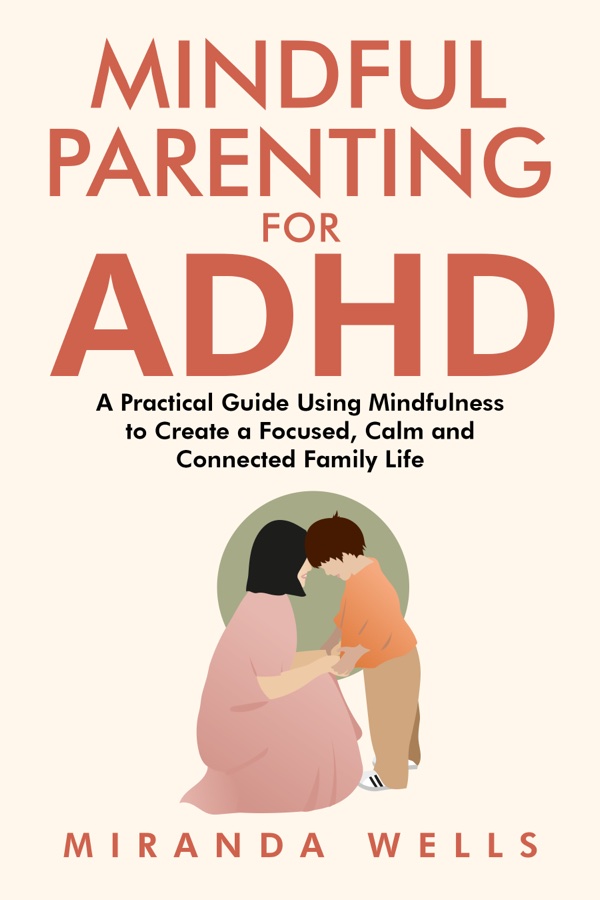
A practical guide to a more focused, calm and connected family life. Step-by-step routines that work in real homes, word-for-word scripts for the moments you’re at a loss, checklists for you and for your child, and adaptations from preschool to teens.
| What it covers | The whole day. The 7:36 a.m. kitchen, the after-school crash, homework, bedtime for a restless brain, public meltdowns, sibling fights, repairing after a blow-up, and the self-care that has to fit between all of it. |
| How it teaches | Routines, scripts, and checklists, plus honest stories from my own kitchen. No “just try harder” speeches. No one-size-fits-all. |
| Comes with | The Calm Kit · the printables, opened by the QR code inside the book, or right here. |
| Where | Amazon · paperback $9.99 · Kindle $0.99 |
Both editions are on Amazon. The paperback has the QR code to the Calm Kit printed inside; the Kindle edition has the tappable link. Either way, the kit is yours.
You’re the exact reader. Nothing in the book asks a child with ADHD to sit still, be quiet, or empty their mind. The practices move: a wake-up wiggle, wall pushes, a sixty-second huddle with giggling in it, spy senses in the frozen-food aisle. Presence, not stillness.
Because it isn’t another system to keep up with. Sticker charts, time-outs and rigid routines fail ADHD families for a reason, and the first chapter says plainly what that reason is. Mindfulness meets you where you are, in the moment that’s already happening, and lets you start again in the next one.
No. If you never sit on a cushion, the book still works. The smallest unit is one breath, and most of what’s in it happens standing up, in a car, or with a hand on the fridge.
No. This is a book about presence and connection, not treatment. It never tells you what to do about medication or diagnosis, and it isn’t a substitute for the care of your child’s doctor or therapist. It’s the part that happens in the kitchen, between appointments.
I wrote it with moms in front of me, because they’re who I’ve walked beside. Dads, grandparents, and anyone raising a child with ADHD will find the scripts and routines fit their hands just as well.
The printable companions to the book: the Morning Huddle, the Meltdown Map, Pause Phrases, the Repair Ritual, the Bedtime Wind-Down, the Family Check-In, and more, plus three extras written for the parent, including a thirty-day read and a pocket card for the meltdown minute. It’s free, and your email address is the key.
The ADHD book started with the child. Everything after it starts with the woman standing in the kitchen.
For the woman who takes care of everyone else first and calls the leftovers self-care. Journals and a longer read about learning to speak to yourself the way you’d speak to a friend after her worst day.
The patterns that make you disappear inside someone else’s needs, and the slow, unglamorous work of walking out of them. A workbook, because this one needs your handwriting.
Not the version that keeps the peace. The same practices from the same cushions, pointed at the oldest question there is, and written for a Tuesday night, not a mountaintop.
The Calm Kit arrives the moment you join. After that, you hear from me when there’s a new book or a new page for the fridge, and not in between.
The same link is on its way to your inbox, so you can come back to it on a harder day.
 Miranda Wellscome back to yourself